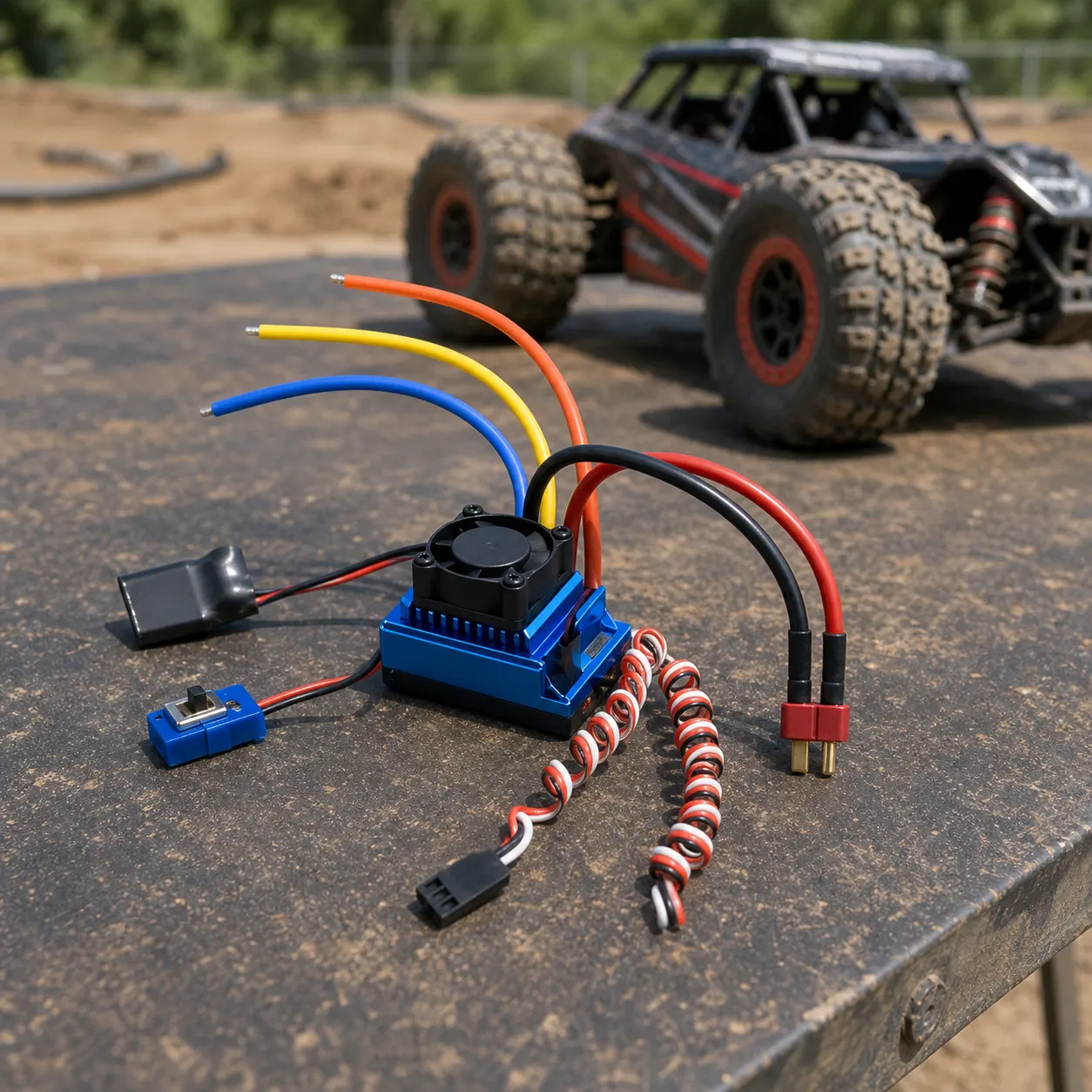
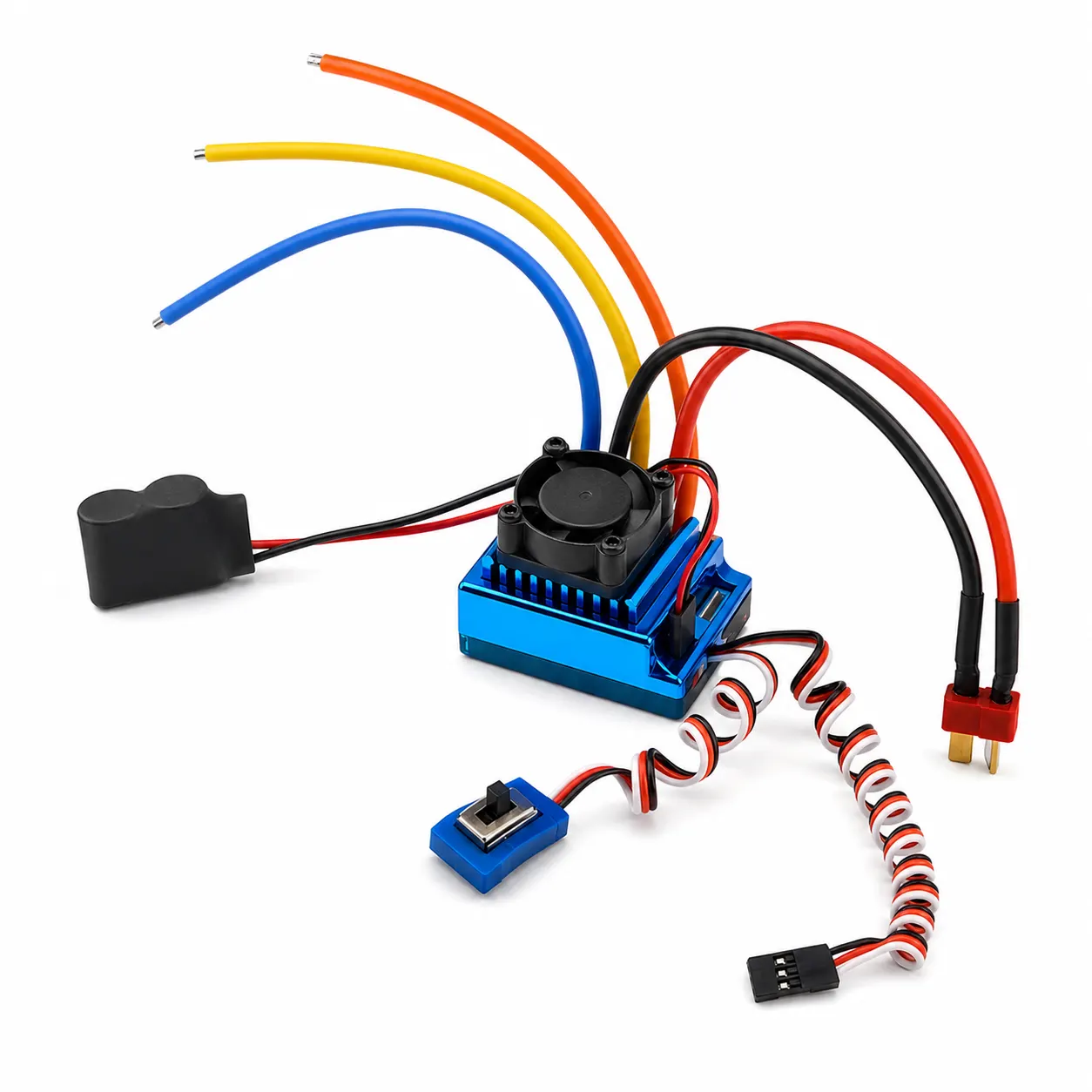
Short answer: An electronic speed controller for an RC car manages the motor response from the radio system, but choosing one still requires a whole-car check. Dilwercbru lists a blue 120A RC car electronic speed controller with remote-control operation and alloy material. The page does not identify a motor family, voltage range, connector set, receiver standard, chassis dimensions or waterproofing. Use the product facts to identify the part, then compare the controller with the motor, battery, receiver, transmitter and physical mounting space already in your vehicle. That keeps the buying decision inside evidence rather than assumptions.
Understand the controller's role
In a typical RC car, the ESC receives a control signal and governs power to the motor. That broad description explains why a controller can affect throttle response, but it does not identify the exact electronics in every car. The current listing only confirms the RC car category, blue 120A description, remote-control operation and alloy material.
Do not read the product as a complete power system. The page does not say that a motor, battery, charger, receiver, transmitter, programming card or installation hardware is included. Manufacturer does not specify the contents beyond the listed controller description.
| System part | Why it matters | Current product-page answer |
|---|---|---|
| Motor | The controller must suit the motor system | Motor type is not specified |
| Battery | Voltage, cells and plug affect fit | Range and connector are not specified |
| Receiver and transmitter | They provide the control signal | Compatibility is not specified |
| Chassis | Space and fixing affect installation | Dimensions and mounting are not specified |
Trace the signal and power path
Before ordering, map the route from transmitter to receiver, from receiver to ESC and from ESC to motor and battery. This is a practical way to find the information a product title cannot provide. A controller that looks suitable can still fail to fit because the plug, lead, motor system or battery arrangement is different.
The listing's remote-control wording describes the intended use context, not a named radio protocol. Manufacturer does not specify receiver type, transmitter settings, throttle calibration method or programming functions.
- Identify the existing controller and label every connected lead before disconnecting power.
- Confirm whether the motor is brushed, brushless, sensored or sensorless from the car documentation.
- Record battery voltage, cell information and connector shape from the current setup.
- Measure the available controller space and check the receiver lead route.
- Compare all notes with the product page and stop where manufacturer does not specify the needed match.
Separate diagnosis from replacement
If the car steers but does not drive, an ESC problem is possible, yet the symptom can also come from power, wiring, motor, receiver or transmitter settings. A new controller is not evidence of a diagnosis. Inspect the existing system first and describe the fault precisely before choosing a part.
The same caution applies to performance language. A 120A label is not a published speed increase, runtime result, heat limit or guarantee that the car will handle differently. The product page does not support those claims.
Limits and checks before buying
The product may fit a buyer who has an RC car controller replacement job and can independently verify the motor, battery, receiver, connector and mounting requirements. It should not be presented as a universal ESC or a guaranteed fix for a throttle fault.
Manufacturer does not specify voltage range, motor support, connectors, dimensions, waterproofing, programming, service life, safety certification or exact compatibility. Obtain those facts before relying on the controller in a setup where any one of them is essential.
Related guides and product details
Use the product page to identify the controller category, then let the existing RC car documentation decide compatibility. Read RC Motor Controller Replacement: Check Fit Before Installation for related guidance. Read 120A ESC for an RC Car: Checks Before Buying for related guidance. Review the documented specification on the 120A RC Car Electronic Speed Controller, Blue product page before ordering.
Sources and safety context
- Supports the listed controller role, blue 120A description, RC car category, remote-control operation and alloy material. Current Dilwercbru RC car electronic speed controller product page.